
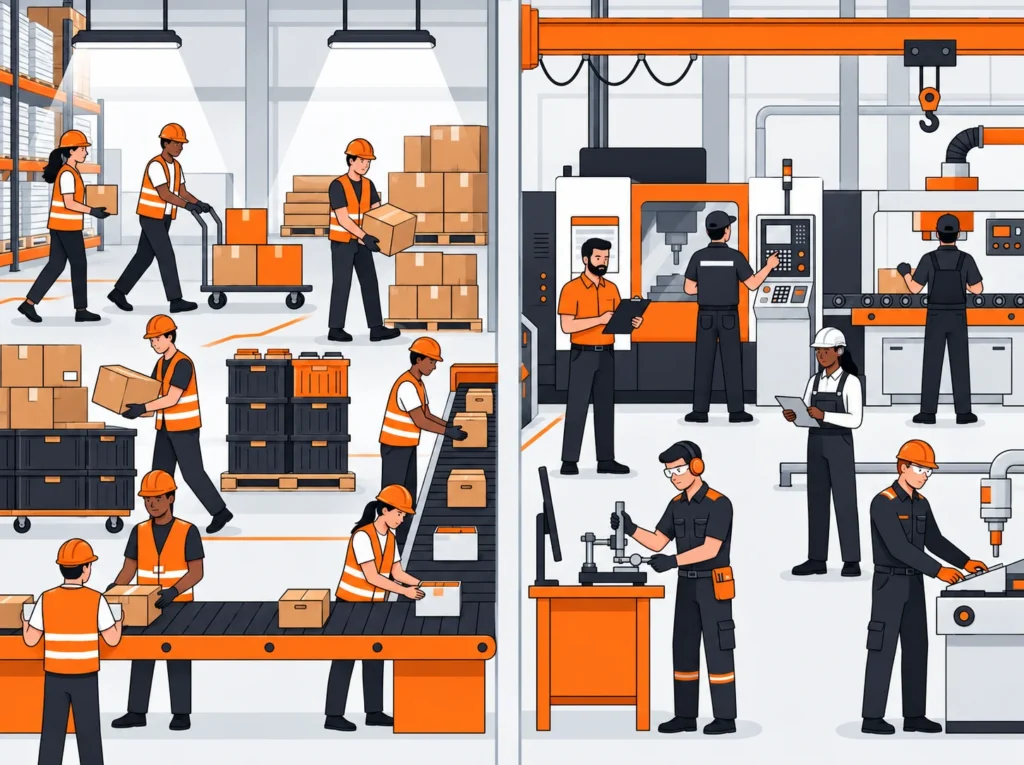
Temporary staffing works well for manufacturing plants that need flexibility during seasonal demand, urgent production requirements, or short-term projects. Permanent staffing is better for long-term roles that require stability, experience, and employee retention. For many manufacturing businesses, a combination of temporary and permanent staffing provides the right balance between flexibility and workforce stability.
Key Takeaways
- Temporary staffing helps manufacturers manage changing workforce requirements.
- Permanent staffing provides stability and supports long-term employee retention.
- Temporary workers can be useful during seasonal production peaks.
- Permanent employees are often better suited for critical and skilled positions.
- A hybrid staffing model can help manufacturing plants balance cost, flexibility, and productivity.
- Professional staffing services for manufacturing can make workforce management easier.
What Is Temporary Staffing?
Temporary staffing means hiring employees for a specific period, project, production cycle, or business requirement. These workers may be hired through a staffing agency and deployed at the manufacturing facility.
Manufacturing plants often experience fluctuations in workforce demand. For example, production may increase during festive seasons, in response to large orders, new product launches, or expansion projects. Temporary staffing allows businesses to increase their workforce without making every position permanent.
Benefits of Temporary Staffing
1. Workforce flexibility
Manufacturers can increase or reduce their workforce based on production requirements. This can be especially useful for businesses with seasonal or unpredictable demand.
2. Faster hiring
Staffing agencies can maintain candidate pools and help businesses fill open positions faster than traditional recruitment processes.
3. Useful for seasonal demand
If a manufacturing plant receives additional orders for a few months, temporary workers can help meet production targets without creating a long-term workforce commitment.
4. Reduced recruitment workload
A staffing partner can handle activities such as candidate sourcing, screening, documentation, payroll coordination, and other workforce-related processes.
What Is Permanent Staffing?
Permanent staffing involves hiring employees for long-term positions within an organization. These employees generally become part of the company’s regular workforce and are hired to support ongoing business operations.
Permanent employees can be particularly valuable for roles that require technical knowledge, experience with specific machinery, leadership skills, or strong familiarity with the company’s processes.
Benefits of Permanent Staffing
1. Better workforce stability
A permanent workforce can provide consistency in daily operations and help manufacturing plants maintain experienced teams.
2. Employee experience
Employees who stay with a company for a longer period can develop deeper knowledge of production processes, machinery, quality standards, and workplace procedures.
3. Better retention of skilled workers
Permanent employment can help businesses build a more stable workforce, particularly for specialized and skilled positions.
4. Stronger team development
Long-term employees have more opportunities to develop within the organization and take on additional responsibilities.
Temporary vs. Permanent Staffing: Key Differences
Factor |
Temporary Staffing |
Permanent Staffing |
|---|---|---|
Employment duration |
Short-term or fixed period |
Long-term |
Workforce flexibility |
High |
Moderate |
Best for |
Seasonal demand and projects |
Core business operations |
Hiring speed |
Usually faster |
May take longer |
Workforce stability |
Lower |
Higher |
Training investment |
Often lower for short-term roles |
Higher |
Employee retention |
Generally lower |
Generally higher |
Production fluctuations |
Highly suitable |
Less flexible |
Skilled critical roles |
Depends on requirement |
Usually suitable |
Which Staffing Model Is Better for Manufacturing Plants?
There is no single staffing model that works for every manufacturing plant. The right approach depends on production volume, workforce requirements, skill levels, business cycles, and long-term plans.
Choose Temporary Staffing When:
- Production demand changes frequently.
- You need workers for a specific project.
- Seasonal orders create additional workload.
- You need to fill multiple positions quickly.
- You are expanding production temporarily.
- You want workforce flexibility during uncertain demand.
For example, an automobile component manufacturer receiving a large short-term order may need additional machine operators, helpers, packers, or warehouse workers. Temporary staffing can help the company manage this increase without permanently expanding its workforce.
Choose Permanent Staffing When:
- The position is required throughout the year.
- The role requires specialized technical knowledge.
- Employees need extensive training.
- Long-term experience is important.
- The role involves supervision or management.
- Employee retention is a major priority.
For example, production supervisors, experienced technicians, quality control specialists, maintenance professionals, and plant managers may be better suited to permanent employment because their knowledge and experience directly support ongoing operations.
Why Manufacturing Plants Use a Hybrid Staffing Model
Many manufacturing businesses do not have to choose between temporary and permanent staffing. A hybrid staffing model can combine both approaches.
Core positions can be filled with permanent employees, while temporary workers can be added when production requirements increase.
For example, a plant could maintain a permanent team of supervisors, technicians, quality professionals, and experienced operators while using temporary workers for packaging, material handling, assembly support, or additional production requirements during peak periods.
This approach can provide manufacturers with both workforce stability and staffing flexibility.
How to Choose the Right Staffing Strategy
Before deciding on a staffing model, manufacturing businesses should consider:
1. Production Demand
Look at current production levels and expected demand over the next few months.
2. Skill Requirements
Identify which positions require specialized skills and which can be filled with trained entry-level workers.
3. Workforce Costs
Consider recruitment, training, payroll, benefits, compliance, and employee replacement costs.
4. Employee Turnover
High turnover in certain positions may make flexible staffing solutions more practical.
5. Business Growth
Companies expecting rapid expansion may need a staffing strategy that can scale quickly.
6. Compliance and Payroll Management
Manufacturing employers must also consider employment documentation, wage requirements, attendance, payroll processing, and applicable labor compliance.
How Staffing Partners Help Manufacturing Businesses
Managing a large industrial workforce can be time-consuming. A professional staffing partner can support businesses with manpower recruitment, employee documentation, payroll processing, workforce deployment, and related administrative activities.
This allows manufacturing companies to focus more on production, quality, and business growth while their workforce requirements are managed systematically.
How Validate Payroll LLP Can Help
Validate Payroll LLP helps businesses manage workforce and payroll-related requirements with practical staffing support. For manufacturing companies, the right workforce strategy can make it easier to respond to changing production requirements while maintaining operational continuity.
Whether a business needs temporary manpower for a production peak or permanent employees for important long-term positions, choosing the right staffing model is essential.
Final Thoughts
Temporary and permanent staffing both have an important role in manufacturing. Temporary staffing provides flexibility when workforce requirements change, while permanent staffing offers stability and supports long-term skill development.
For many manufacturing plants, the most practical approach is a combination of temporary and permanent staffing. By matching the staffing model to production requirements, skill needs, and business goals, manufacturers can build a workforce that is both flexible and reliable.
Working with an experienced staffing and payroll partner such as Validate Payroll LLP can also help businesses simplify workforce administration and manage changing manpower requirements more efficiently.
Frequently Asked Questions
What is temporary staffing in manufacturing?
Temporary staffing involves hiring workers for a limited period, project, seasonal requirement, or temporary increase in production demand.
What is permanent staffing?
Permanent staffing involves hiring employees for ongoing roles that are expected to continue for the long term within a manufacturing organization.
Is temporary staffing cheaper than permanent staffing?
Not necessarily. The overall cost depends on wages, staffing fees, recruitment, training, benefits, compliance, turnover, and the duration of employment.
When should a manufacturing plant use temporary workers?
Temporary workers can be useful during seasonal demand, large short-term orders, production peaks, expansion projects, or sudden manpower shortages.
Which roles are suitable for permanent staffing?
Roles requiring specialized knowledge, long-term training, supervision, technical expertise, or extensive knowledge of company processes are often better suited to permanent staffing.
Can a manufacturing company use both temporary and permanent employees?
Yes. A hybrid staffing model allows a company to maintain permanent employees for core positions while using temporary workers to manage fluctuations in production demand.