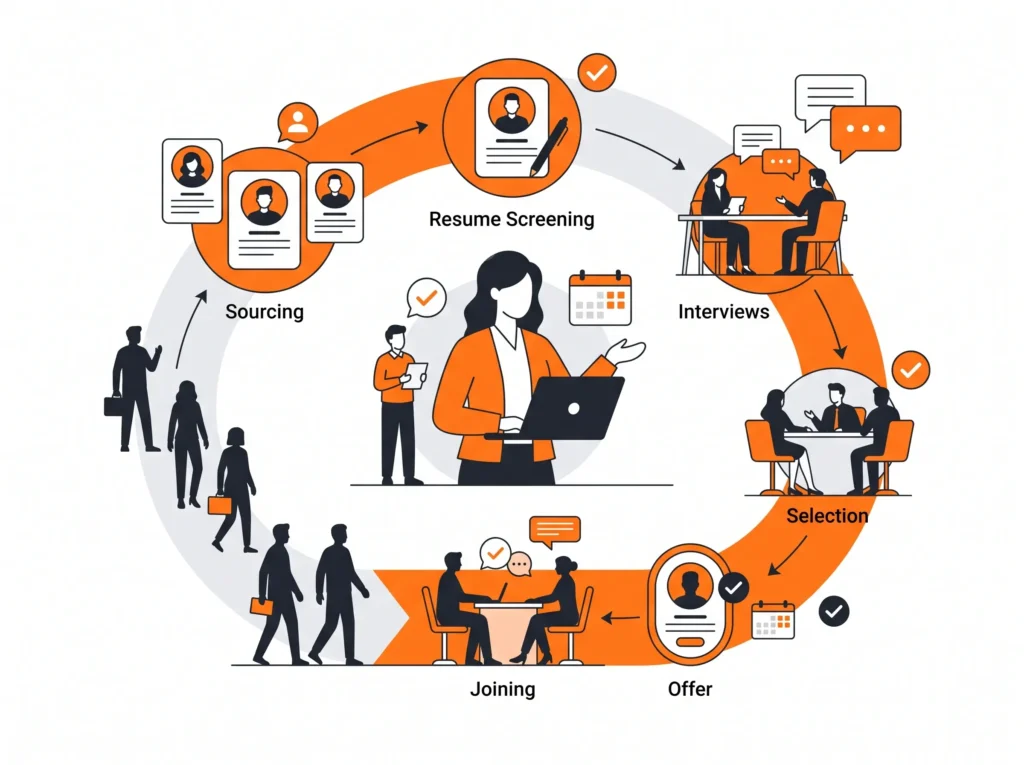
Recruitment Process Outsourcing (RPO) is a hiring solution in which a business outsources part or all of its recruitment process to an external recruitment provider. An RPO provider can manage candidate sourcing, resume screening, shortlisting, interview coordination, candidate communication, and joining support. RPO helps businesses reduce HR workload, improve hiring efficiency, access recruitment expertise, and scale recruitment when hiring needs increase.
Hiring the right employees is important for every growing business. However, recruitment can become time-consuming when a company has multiple vacancies, needs specialised talent, or has to hire a large workforce quickly.
This is where Recruitment Process Outsourcing can make a difference.
For businesses looking for professional hiring support, working with a recruitment consultancy in Vadodara can provide access to recruitment expertise while reducing the workload on internal HR teams.
What Is Recruitment Process Outsourcing?
Recruitment Process Outsourcing, commonly called RPO, is a recruitment model where an external service provider manages some or all of a company’s hiring activities.
Instead of handling every recruitment task internally, a business can outsource selected activities to an RPO provider.
Depending on the agreement, an RPO provider may manage:
- Understanding job requirements
- Creating job descriptions
- Candidate sourcing
- Resume screening
- Candidate shortlisting
- Interview scheduling
- Candidate communication
- Recruitment reporting
- Offer coordination
- Joining follow-ups
The level of support can be customised according to the company’s hiring requirements.
How Does RPO Work?
RPO works through a structured recruitment process designed around the employer’s hiring needs.
1. Understanding the Hiring Requirements
The RPO team first understands the company’s open positions, required qualifications, experience, skills, salary range, job responsibilities, and expected joining date.
This creates a clear candidate profile for each vacancy.
2. Creating a Recruitment Strategy
Once the requirements are clear, recruiters decide how to reach suitable candidates.
Depending on the position, sourcing can include job portals, professional networks, candidate databases, referrals, recruitment campaigns, and direct candidate outreach.
3. Finding Suitable Candidates
Recruiters actively search for candidates who match the required profile.
For specialised positions, recruiters may use multiple sourcing methods to reach candidates who may not be actively applying for jobs.
4. Screening and Shortlisting
Applications are reviewed against the company’s requirements.
Recruiters may assess:
- Education
- Work experience
- Technical skills
- Industry knowledge
- Communication skills
- Relevant job experience
- Other role-specific requirements
Suitable candidates are then shortlisted for the next stage.
5. Interview Coordination
The recruitment team coordinates interviews between shortlisted candidates and the company’s hiring managers.
This may include scheduling interviews, communicating interview details, collecting feedback, and updating candidates about the recruitment process.
6. Offer and Joining Support
After a candidate is selected, the RPO team can assist with offer communication, documentation, joining coordination, and follow-ups.
This helps reduce communication gaps between selection and joining.
What Are the Benefits of RPO for Businesses?
The major RPO benefits for businesses include faster hiring, reduced HR workload, better candidate sourcing, recruitment expertise, scalable hiring, and improved candidate experience.
Faster Recruitment
A dedicated recruitment team can continuously focus on sourcing and screening candidates.
This can help businesses reduce the time required to fill vacancies, especially when employees are needed quickly for expansion or operational requirements.
Reduced HR Workload
Recruitment involves several repetitive tasks, including searching for candidates, reviewing resumes, scheduling interviews, and following up with applicants.
Outsourcing these activities allows internal HR teams to focus on employee engagement, training, performance management, and other important responsibilities.
Access to Recruitment Expertise
Professional recruitment providers understand candidate sourcing, screening, hiring trends, and recruitment challenges.
Businesses can use this expertise without having to build a large internal recruitment team.
Better Candidate Screening
Getting a large number of resumes does not guarantee finding the right employee.
An RPO team can use defined screening criteria to identify candidates who are more closely aligned with the job requirements.
This allows hiring managers to focus their time on more relevant candidates.
Scalable Hiring Support
Hiring requirements can change quickly.
A company may need only a few employees during normal operations but require a much larger workforce during expansion, new projects, seasonal demand, or business growth.
RPO allows recruitment capacity to increase when hiring requirements increase.
Improved Candidate Experience
Candidates value clear and timely communication.
A dedicated recruitment team can keep applicants informed about interviews, selection stages, documentation, and joining requirements.
This creates a more organised and professional hiring experience.
RPO vs Recruitment Agency: What Is the Difference?
RPO and traditional recruitment agencies both help businesses hire employees, but their involvement can be different.
A recruitment agency in Vadodara may primarily focus on sourcing and recommending candidates for particular vacancies.
An RPO provider can take responsibility for a wider part of the recruitment process and work closely with the company’s internal HR team.
RPO |
Recruitment Agency |
|---|---|
Can manage part or all of recruitment |
Usually focuses on specific vacancies |
Works closely with internal HR |
Works as an external recruitment partner |
Suitable for ongoing hiring |
Often suitable for targeted hiring |
Can support high-volume recruitment |
Can support individual or multiple vacancies |
The process can be customised |
Usually focused on agreed positions |
Neither option is automatically better. The right choice depends on the company’s hiring volume, budget, workforce requirements, and internal HR capabilities.
When Should a Business Consider RPO?
A business should consider RPO when it:
- Has frequent hiring requirements
- Needs to recruit employees at scale
- Is expanding its operations
- Has a small internal HR team
- Struggles to find skilled candidates
- Needs to fill vacancies quickly
- Requires additional recruitment capacity
- Wants to improve its hiring process
- Is planning bulk recruitment
Businesses can also outsource only specific recruitment activities instead of their entire hiring process.
How Can RPO Help Businesses in Vadodara?
Vadodara has businesses across manufacturing, engineering, pharmaceuticals, chemicals, IT, services, and other industries. These sectors can have different workforce requirements and recruitment challenges.
For example, a manufacturing company may need skilled technical workers, while a service business may require sales, administrative, or customer-support employees.
An RPO model can provide flexible recruitment support based on these different requirements.
For companies searching for placement consultants in Baroda, an RPO approach can be particularly useful when the business needs continuous hiring support, bulk recruitment, or additional recruitment capacity during expansion.
What Should You Check Before Choosing an RPO Provider?
Before selecting an RPO or recruitment partner, businesses should check:
Industry Experience
Does the provider understand your industry and the type of employees you need?
Candidate Sourcing
Does the provider use multiple channels to find suitable candidates?
Screening Process
How does the provider evaluate candidates before recommending them?
Recruitment Capacity
Can the provider handle your current and expected hiring volume?
Communication
Will you receive regular updates about vacancies, candidates, interviews, and hiring progress?
Flexibility
Can the recruitment service scale up or down as your hiring needs change?
Reporting
Does the provider track recruitment activities and hiring performance?
A good recruitment partner should focus on both candidate quality and recruitment efficiency, rather than simply sending a high number of resumes.
Final Thoughts
Recruitment Process Outsourcing provides businesses with a flexible way to manage recruitment without handling every hiring activity internally.
From candidate sourcing and screening to interview coordination and joining support, an RPO provider can manage multiple stages of recruitment through one structured process.
For businesses in Vadodara, this can be especially useful when hiring requirements increase, skilled candidates are difficult to find, or internal HR teams need additional recruitment support.
Validate Payroll LLP can help businesses looking for organised recruitment solutions based on their workforce requirements. Whether the need involves regular hiring, specialised recruitment, or bulk workforce requirements, businesses should choose a recruitment approach that matches their hiring goals, timeline, and resources.
Ultimately, the goal of RPO is simple: to make recruitment more efficient, scalable, organised, and focused on finding the right people for the right roles.
Frequently Asked Questions About RPO
What does RPO stand for in recruitment?
RPO stands for Recruitment Process Outsourcing. It is a recruitment model where a business outsources part or all of its recruitment activities to an external recruitment provider.
What does an RPO provider do?
An RPO provider can handle candidate sourcing, resume screening, shortlisting, interview scheduling, candidate communication, recruitment reporting, offer coordination, and joining follow-ups.
Is RPO suitable for small businesses?
Yes. Small businesses can use RPO when their internal HR team has limited recruitment capacity or when they need additional hiring support during business growth.
Is RPO useful for bulk hiring?
Yes. RPO can be useful for bulk hiring because a dedicated recruitment team can manage multiple vacancies and a larger candidate pipeline at the same time.
What is the difference between RPO and a recruitment agency?
A recruitment agency generally helps businesses fill specific vacancies, while RPO can manage a broader part of the recruitment process and operate as an extension of the company’s HR team.
How does RPO reduce HR workload?
An RPO provider can handle sourcing, screening, interview coordination, candidate communication, and recruitment follow-ups. This allows internal HR professionals to focus on other business and employee-related responsibilities.
Can businesses in Vadodara use RPO services?
Yes. Businesses in Vadodara can use RPO for regular recruitment, specialised hiring, bulk hiring, workforce expansion, and additional recruitment support.
Is RPO suitable for growing companies?
Yes. Growing companies can use RPO when their recruitment requirements increase faster than their internal HR team’s ability to manage hiring.